Showing posts with label business leadership qualities. Show all posts

Monday, September 9, 2013

How Smart People Tackle FAILURE Head On!


Photo: Courtesy of Chris Griffith via Flickr
Best-selling author John C. Maxwell, invites us to take a look at a topic that makes most people cringe.  Whether reflecting on a mistake made 10 years ago or 10 minutes ago, Maxwell makes argument for not allowing our failures to cause us to cower in fear and regret; rather, he encourages people to embrace the reality of our mistakes so that we can move forward and use them to our benefit.  He even goes a step further by evaluating what contributes to a person's level of success.  

Below is an excerpt from his book, Failing Forward: Turning Mistakes Into Stepping Stones For Success, where he examines the common misconceptions about the reasons or factors having contributed toward people's successes.  In turn, we can fall into the trap of minimizing others' success when we focus on a particular factor that we believe led them down that much envied road, instead of paying careful attention to what Maxwell calls "perception."  
WHAT'S THE ROOT OF ACHIEVEMENT?
What makes the difference?  Why do some people achieve so much?  Is it...
    •  Family background?  Having a good family growing up is something to be grateful for, but it's not a reliable indicator of achievement.  High percentages of successful people come from broken homes.
    • Wealth?  No, some of the greatest achievers come from households of average to below-average means.  Wealth is no indicator of high achievement, and poverty is no guarantee of low achievement.
    • Opportunity?  You know, opportunity is a peculiar thing.  Two people with similar gifts, talents, and resources can look at a situation, and one person will see tremendous opportunity while the other sees nothing.  Opportunity is in the eye of the beholder.
    • High morals?  I wish that were the key, but it's not.  I've known people with high integrity who achieve little.  And I've known scoundrels who are high producers.  Haven't you?
    • The absence of hardship?  For every achiever who has avoided tragedy, there's a Helen Keller who overcame extreme disabilities or a Viktor Frankl who survived absolute horrors.  So that's not it either.
Photo: Courtesy of Amazon.com
No, none of these things are the key.  When it comes right down to it, I know of only one factor that separates those who consistently shine from those who don't:  The difference between average people and achieving people is their perception of and response to failure.  Nothing else has the same kind of impact on people's ability to achieve and to accomplish whatever their minds and hearts desire. 
In the world of entrepreneurial articles and business books alike, there seems to be a common thread with regard to success and achievement:  Perception.  How can such a seemingly insignificant word carry such great weight in how it affects the outcome of our lives?  The interesting part is that it is entirely in our control, how we choose to perceive the situations we face on a daily basis:  do we look at them as opportunities or misfortunes?  

Is there a failure in your business or personal life, which you need to change your perception about? 

In case you missed it, check out The 4-Hour Work Week...SERIOUSLY?!

Sunday, August 25, 2013

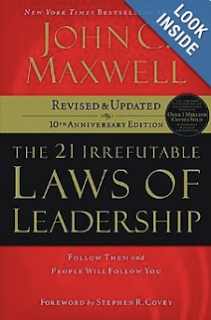
The 21 Irrefutable Laws of Leadership by John C. Maxwell

WHO Comes To Mind When You Think Of Amazing Leadership?

Photo: Courtesy Jim Bowen on Flickr
In this book, John C. Maxwell writes as though his life purpose is to develop your leadership abilities and qualities.  His style makes him both approachable and trustworthy, as someone you might seek out as a mentor.  It is obvious that his life passion is to pass along these "laws of leadership" in an effort to encourage and build up those who are looking to improve their lives in this area.

In writing this 10th Anniversary updated edition, Maxwell explains that while he hasn't changed the laws he wrote about so many years ago, that he has definitely found ways to expand on and improve on those laws that have effectively proven, over and over again, to help so many throughout the years.

He gives some advice for those who decide to read and study his 21 laws of leadership:

Leadership principles are unchanging and stand the test of time.  As you read the following chapters, I'd like you to keep in mind four ideas:

  1.  The laws can be learned.  Some are easier to understand and apply than others, but every one of them can be acquired.
  2. The laws can stand alone.  Each law complements all the others, but you don't need one in order to learn another.
  3. The laws carry consequences with them.  Apply the laws, and people will follow you.  Violate or ignore them, and you will not be able to lead others.
  4.  These laws are the foundation of leadership.  Once you learn the principles, you have to practice them and apply them to your life.
Whether you are a follower who is just beginning to discover the impact of leadership or a natural leader who already has followers, you can become a better leader...No matter where you are in the leadership process, know this:  the greater number of laws you learn, the better leader you will become.  Each law is like a tool, ready to be picked up and used to help you achieve your dreams and add value to other people.  Pick up even one, and you will become a better leader.  Learn them all, and people will gladly follow you.

Every single person has a leadership role in one way or another.  To say that this subject on leadership development is useless is ignorant on our part.  Every single day, whether directly or indirectly, we are leading and impacting people around us.  

Look around you today and ask yourself who is watching you, and what you need to do to improve the natural leader within.

In case you missed it:   9 Ways To Improve Your Luck in Small Business!